Vouchers
What is a voucher in Powerlynx?
In Powerlynx, a voucher functions like an access card, generated by the system to grant users network access under specific conditions. Each voucher contains detailed information about its validity, traffic limits, online time limits, and the maximum number of devices that can connect using it. It inherits the data plan settings (validity, speed limits, traffic limits, time online limits, etc).
TIP
Customers can also buy vouchers for themselves directly from the customer portal, and use them as an automatically-activating queue. See Buy vouchers from portal.
Voucher Creation and Usage Process:
Creating Data Plans: First, you create a data plan under the Data plans menu with specific limits. For example, you might set a plan with a 10 Mbps upload/download speed, a 1 GB traffic limit, a 1-hour online limit, and a validity of 7 days.
Enabling Data Plans at Locations: Next, you enable this data plan for a specific location.
Customer Interaction: When a customer at that location connects to Wi-Fi, they are redirected to a page where they can select a data plan that suits their needs.
Voucher Generation: Upon selecting a data plan, a new voucher is created with limits as defined in the chosen data plan.
Monitoring and Deactivation: The system continuously monitors the voucher. If any of the set limits are reached (such as the traffic limit or time online), the system deactivates the voucher and disconnects the customer.
Example scenario
Consider a café using Powerlynx to manage its Wi-Fi service. The café wants to control Wi-Fi usage to prevent network abuse. They set up several data plans with different limits and enable these plans for their location.
When a customer orders a coffee, they connect to the Wi-Fi and are prompted to choose a data plan. Suppose they choose a plan with a 1-hour online limit, 1GB data, and 10 Mbps speed, valid for 7 days. As soon as they select the plan, a voucher with these specific limits is generated. If the customer reaches the 1GB data limit or exhausts their 1-hour online time within these 7 days, the voucher is automatically deactivated, and the connection is terminated.
This system ensures fair usage of the café's Wi-Fi and offers the flexibility for customers to choose a plan that best suits their needs, while also providing the café with efficient management and monitoring capabilities.
Explaining the Vouchers menu
You can find the Vouchers menu on the dashboard, located between the Customers and Finance menus:
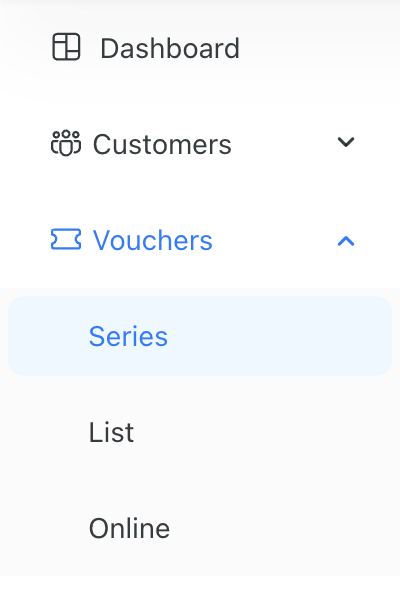
It includes three sub-menus:
- Series - A list of vouchers grouped by series. Each series can contain thousands of vouchers, and we use them to group vouchers created from the same tariff plan during a specific time period:
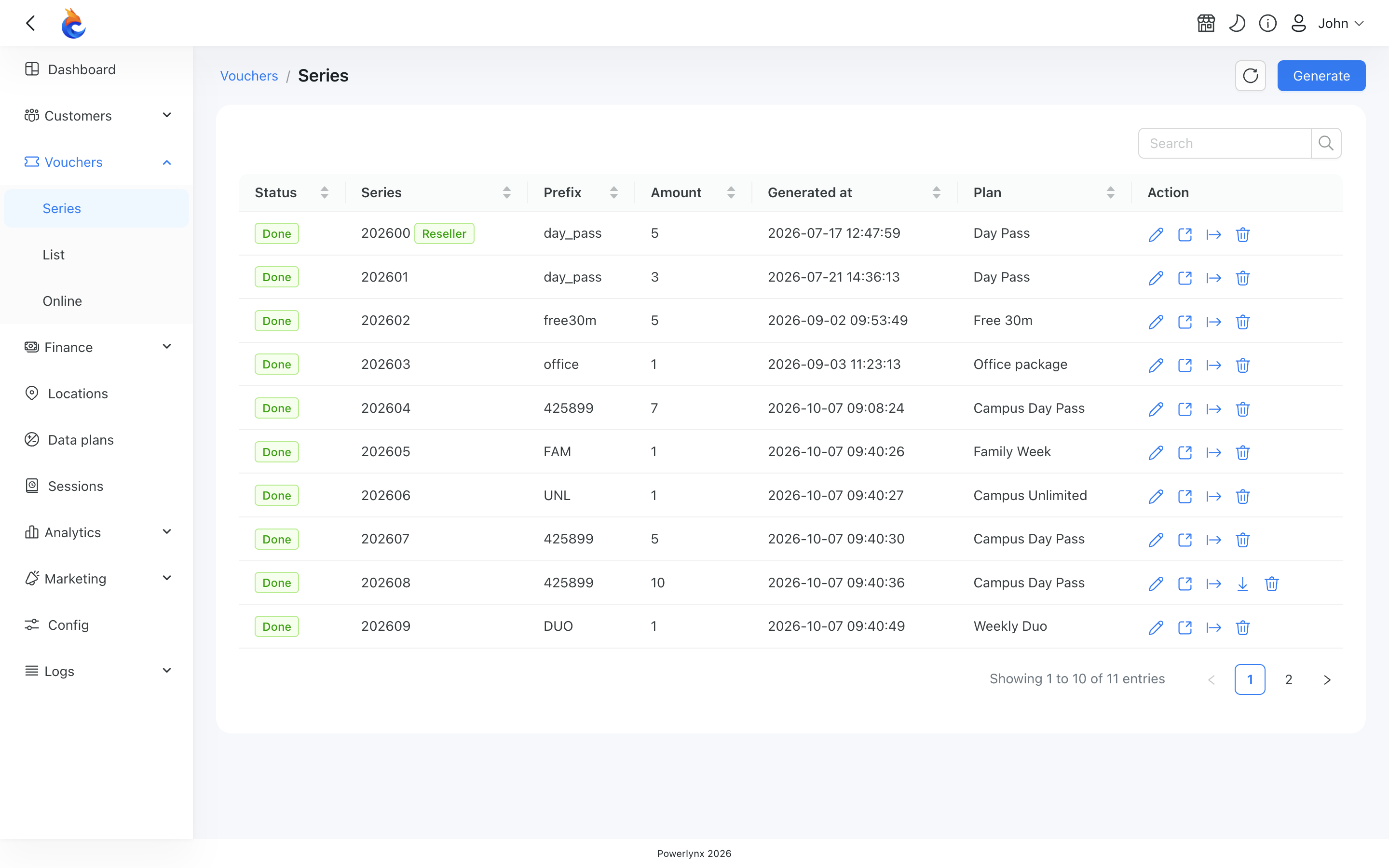
All series are created automatically. However, in some cases, you may need to create a series of fresh vouchers that can be printed. This can be done using the "Generate" button, which opens a form where you can set parameters for a new series:
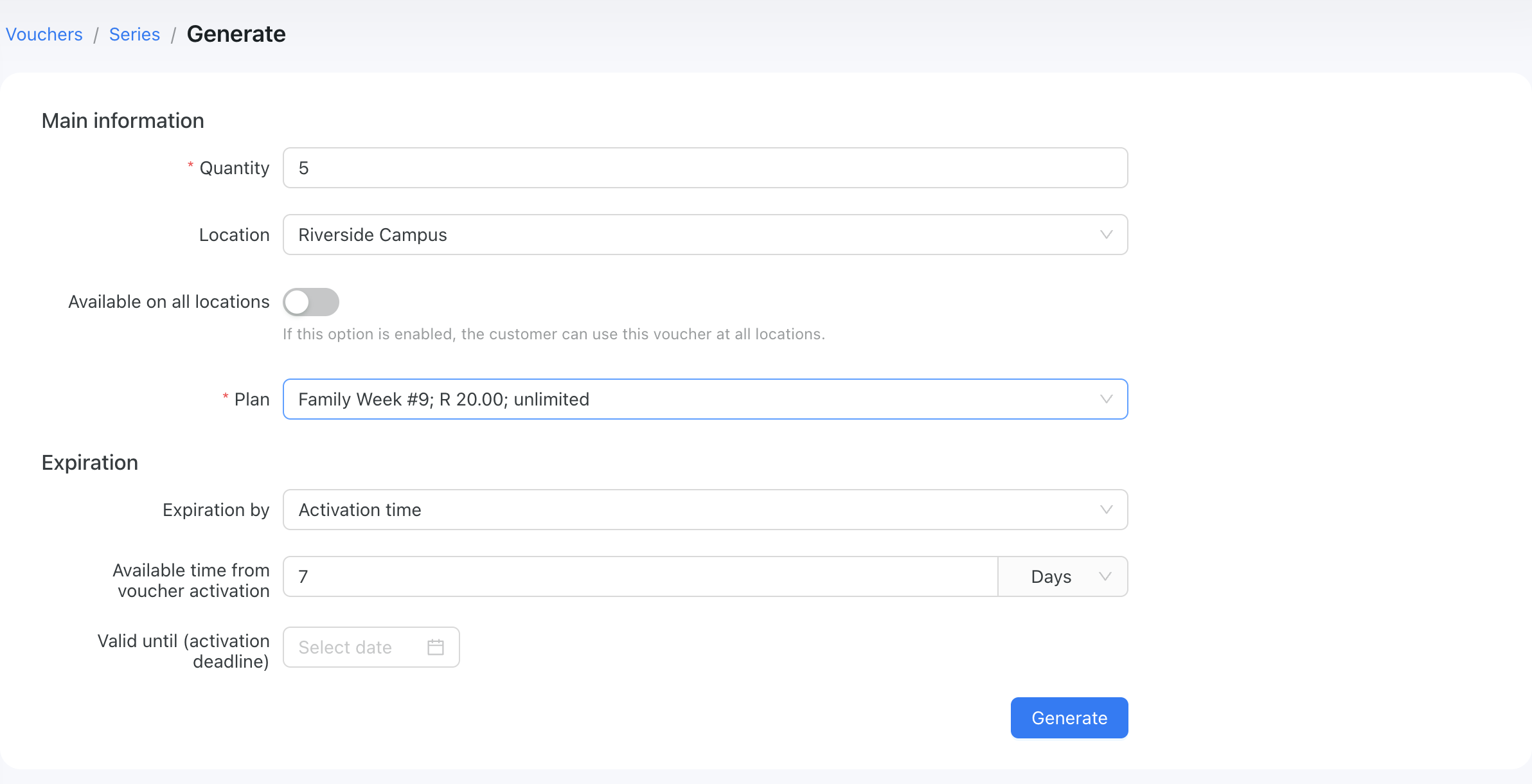
In this example, we generate a series of 5 vouchers from the "Free for Employees" plan, which are designated for use at the "Hotel" location. These vouchers remain valid until the end of their specified validity period. After generation, you will have 5 vouchers that can be utilized in the "Login with Voucher Code" option on a splash page.
TIP
Pay attention to the Expiration section when generating a series. There are two options for setting the expiration method of a voucher:
Expiration by 'Valid Until': This means the generated vouchers are valid until the specified date. They will expire on that date, regardless of whether they have been activated.
Expiration by 'Activation Time': This means the generated vouchers are valid for X days following their activation. For example, if a voucher was generated two months ago but only activated today, the countdown for the "Available time from voucher activation" will begin from the date of activation.
Putting a deadline on activation
"Activation Time" on its own means a voucher can sit unused for as long as it likes — the clock only starts when somebody activates it. That is usually what you want for printed cards, but not always: a batch printed for one event should not still be usable a year later.
So a voucher on Activation Time can also carry a Valid until date, used here as a deadline for being activated at all:
- Activated before that date — the voucher runs for its normal period from the moment of activation, exactly as it would without a deadline. The deadline stops mattering once the voucher is activated, even if the resulting expiry falls after it.
- Never activated, and the date passes — the voucher expires on that date and can no longer be used.
Leave the field empty, which is the default, and nothing changes: the voucher has no expiry at all until it is activated.
INFO
The two dates never apply at once. A voucher on Valid until expires on its date whether or not it was ever activated, and its activation deadline is ignored and cleared. A voucher on Activation Time uses its activation deadline, and the plain "Valid until" date is ignored and cleared. Switching a voucher between the two modes therefore cannot leave a stale date behind that quietly takes effect later.
TIP
Both dates are whole days, interpreted in your system's timezone — a deadline of the 31st means the voucher can still be activated at any point during the 31st.
Vouchers created before this option existed have no activation deadline, so their behaviour is unchanged.
Each serie has 4 actions:
- Edit - Modify certain parameters of a series;
- View - Display the list of vouchers in this series;
- Export - Export the list of vouchers in this series;
- Delete - Remove the series.
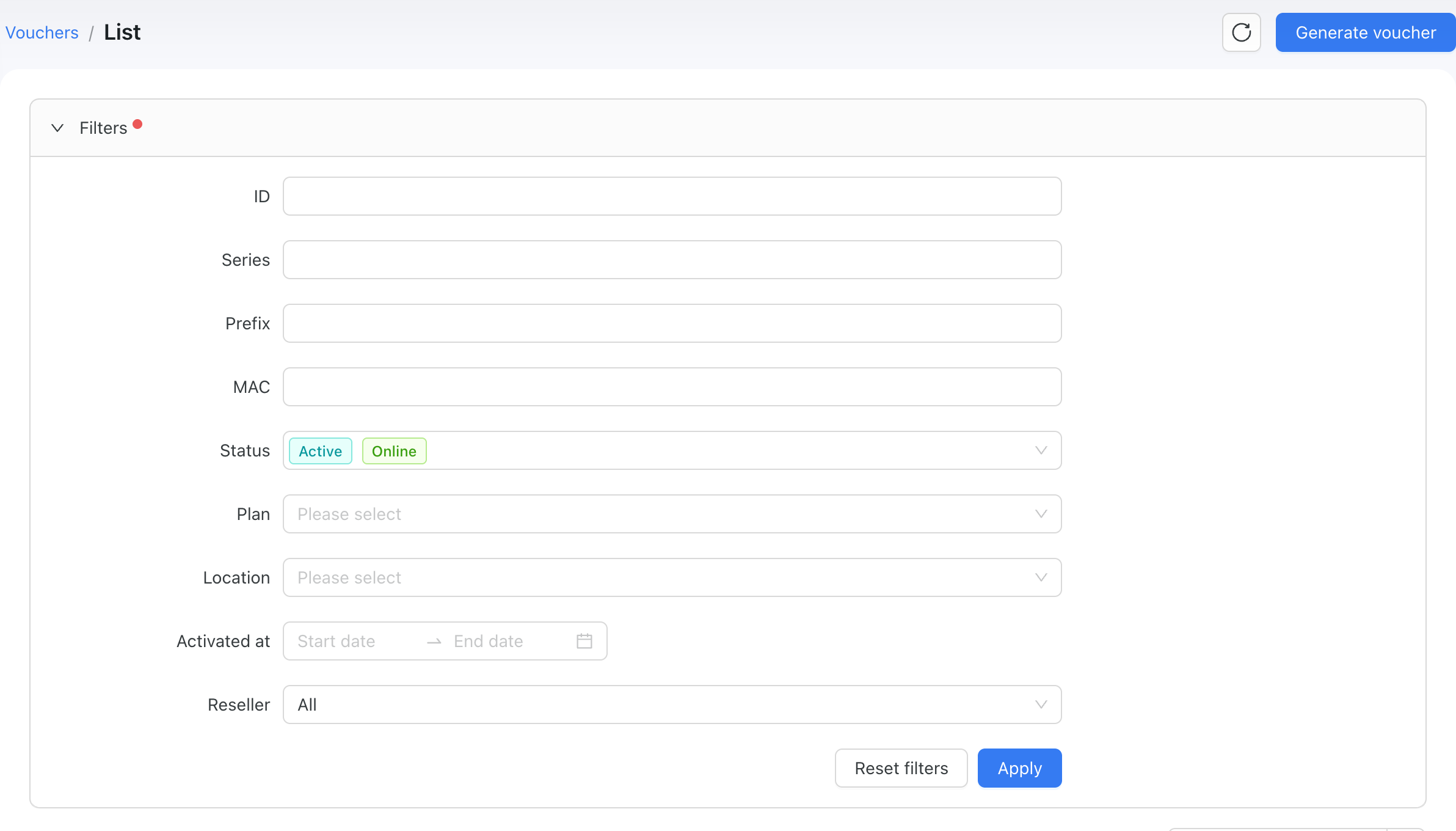
- List - this page contains the list of all vouchers in the system:
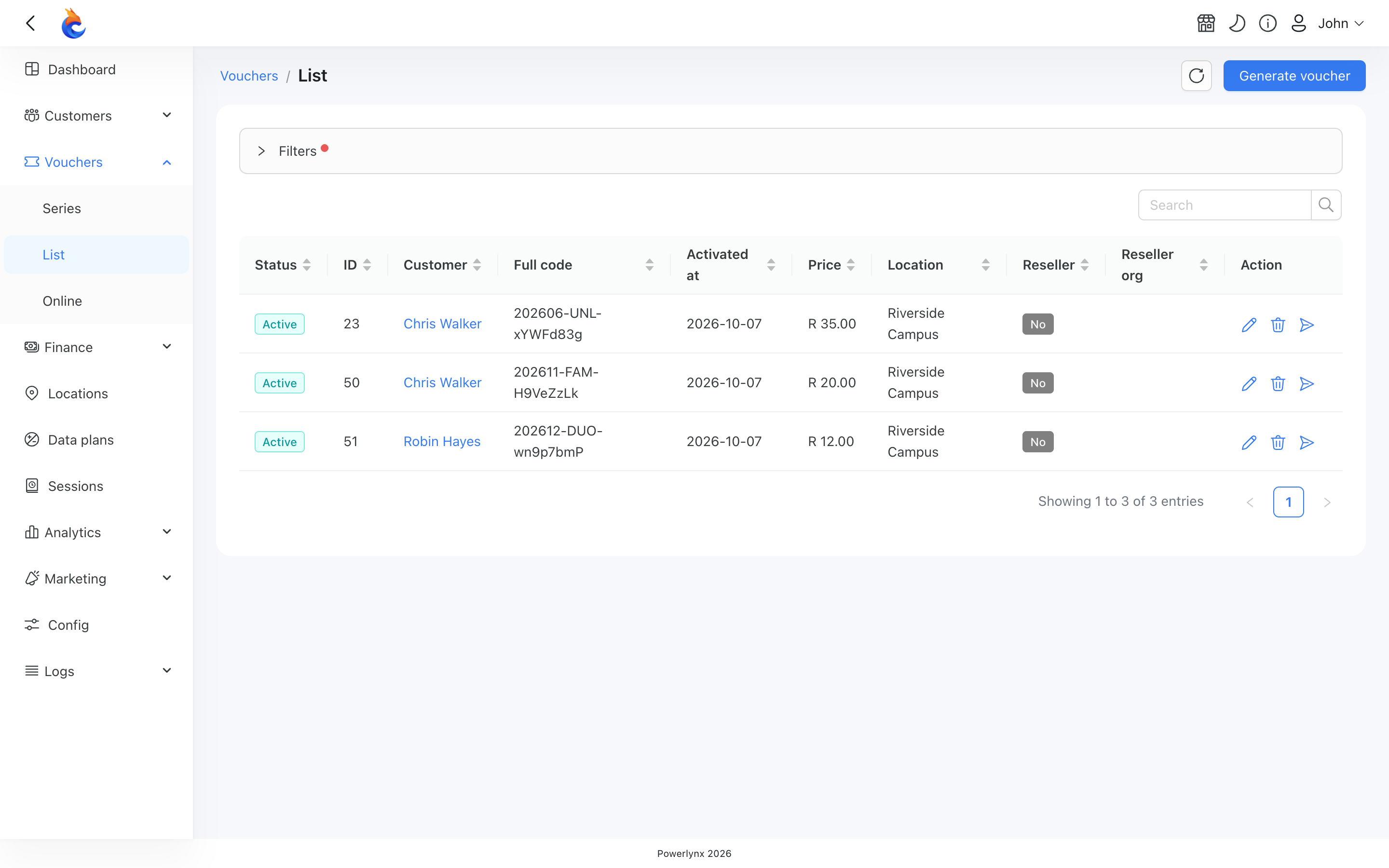
At the top of the list, under the "Filters" tab, we automatically apply a filter by status: Active and Online, to facilitate easier browsing.
- Online - The list includes ONLY online vouchers along with their statistics, IP, MAC, hotspot, and location details.
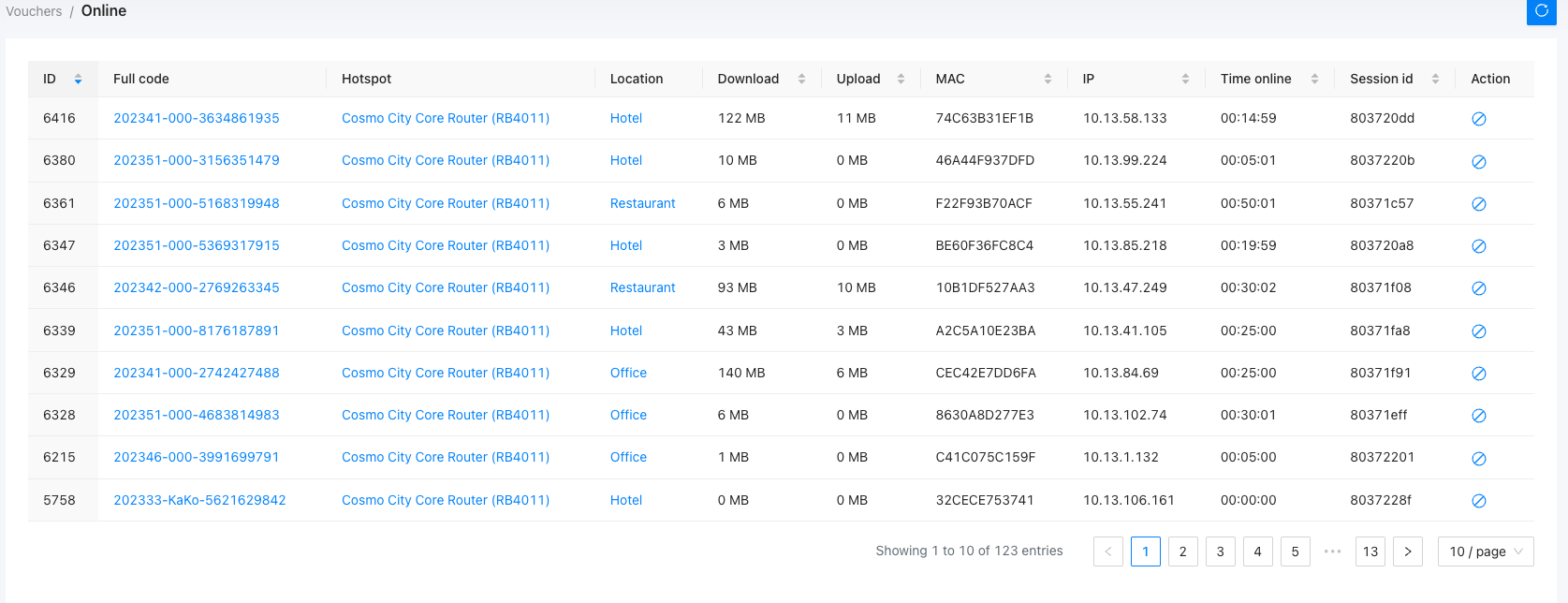
You can disconnect all sessions of these vouchers using the button in the "Action" column.
Voucher availability across locations
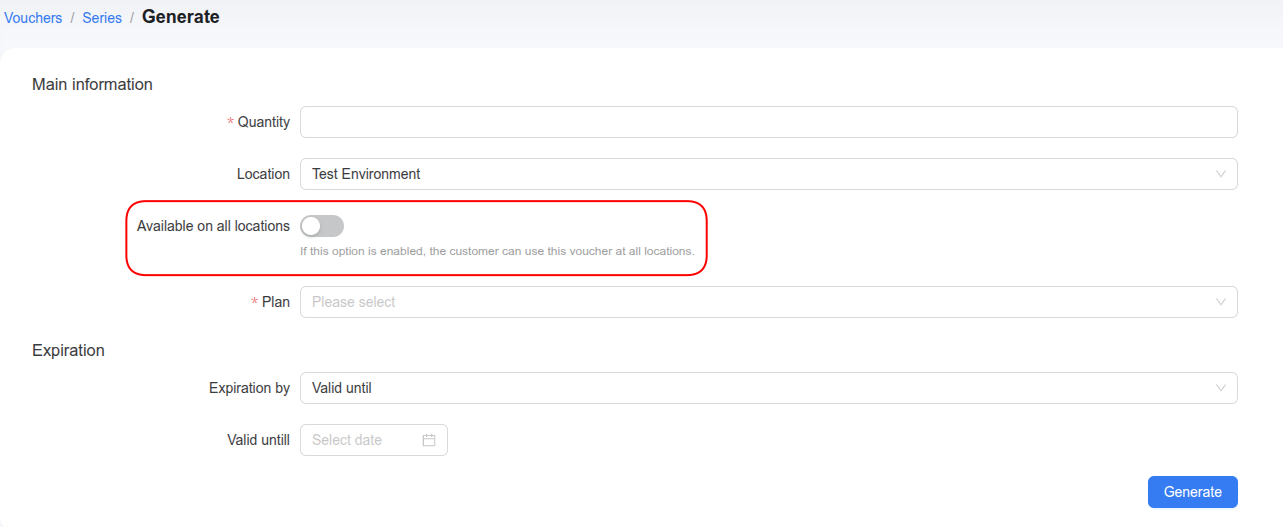
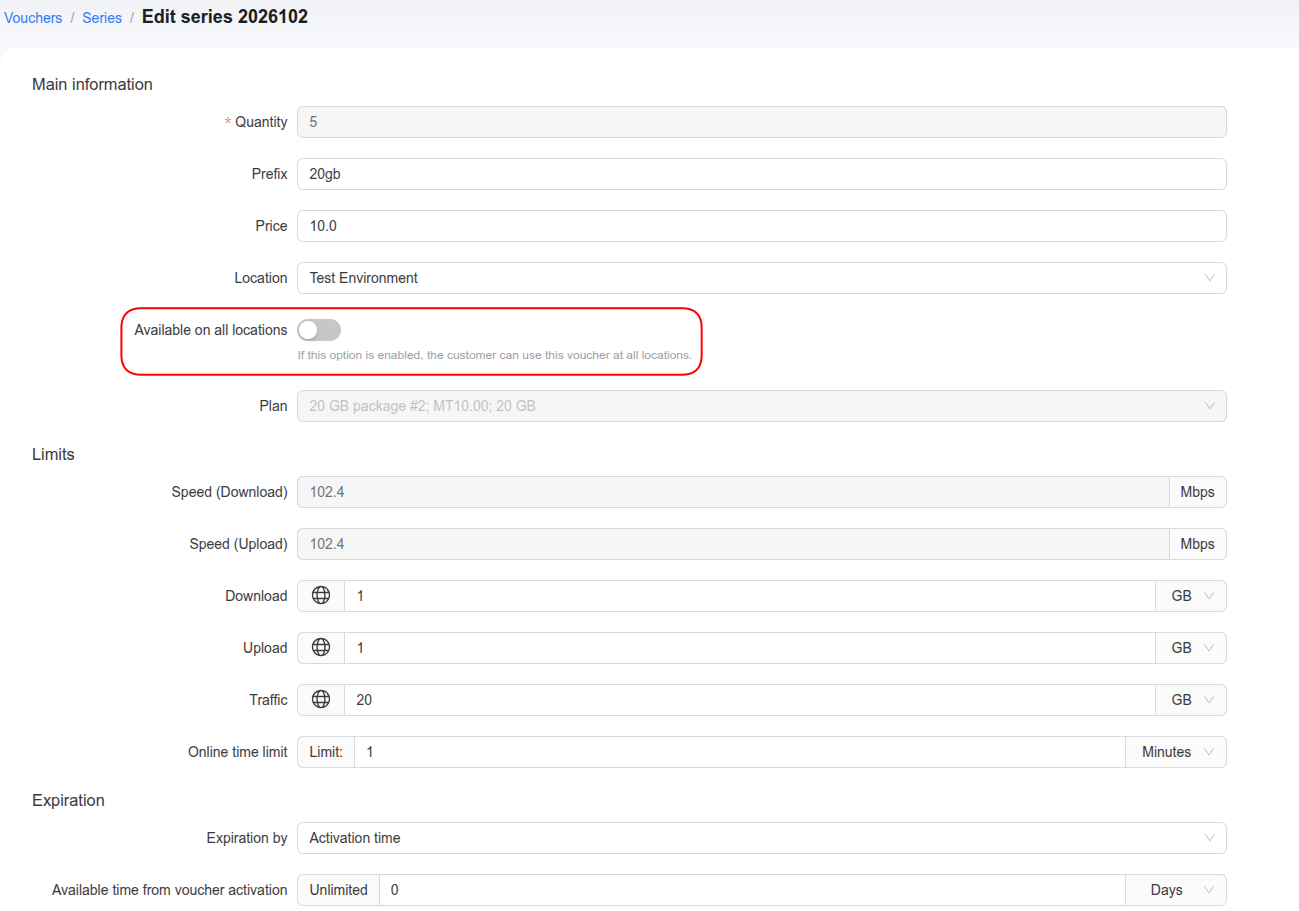
A voucher works on every hotspot and SSID of its own location. To let it work at other locations too, enable Available on all locations:
when generating a series or a single voucher;
on an issued voucher, in its Main tab;

on a series — the change is applied to every voucher of the series except those you have edited individually.
The Multi-locations voucher option on a location's Plans tab only covers vouchers that customers get on the splash page from then on — see Locations.
Voucher settings
There are several voucher settings that can be modified. You can find these under Config/Finance/Main:
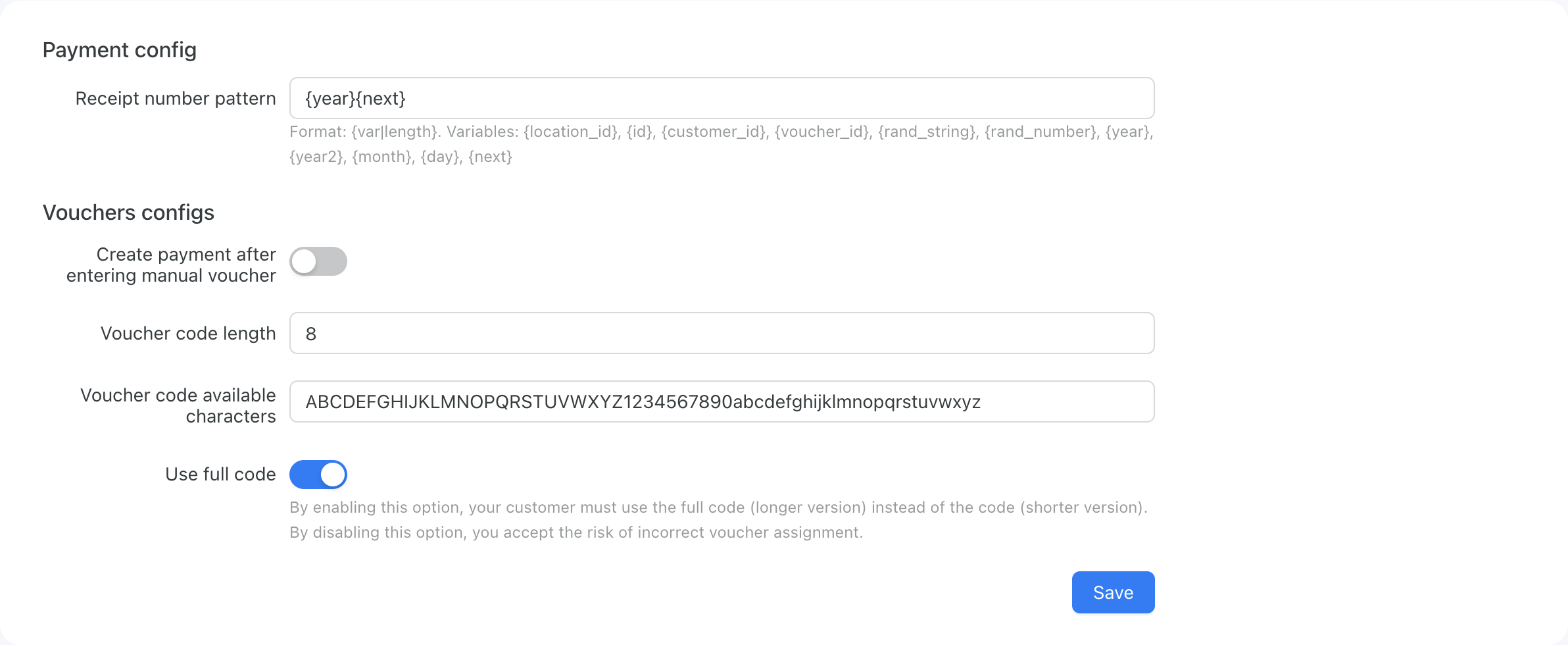
Create payment after entering manual voucher - This option works in conjunction with the "Login using voucher code" feature, which can be enabled for a location under the Payment Gateways tab. If activated, it creates a payment record in the system whenever a customer logs in with a voucher code and the voucher's price is greater than 0. If disabled, the system will not create a payment record for such vouchers but will simply activate them. This option is designed to facilitate better financial monitoring;
Voucher code length - Define the length of a voucher's code;
Voucher code available characters - Choose the set of characters to be used in generating a voucher's code. For example, to make your voucher codes purely numerical, remove all letters and leave only numbers, like
1234567890.Use full code - This option allows your customers to log in using a short voucher code (if disabled) instead of a full one. It is enabled by default.
TIP
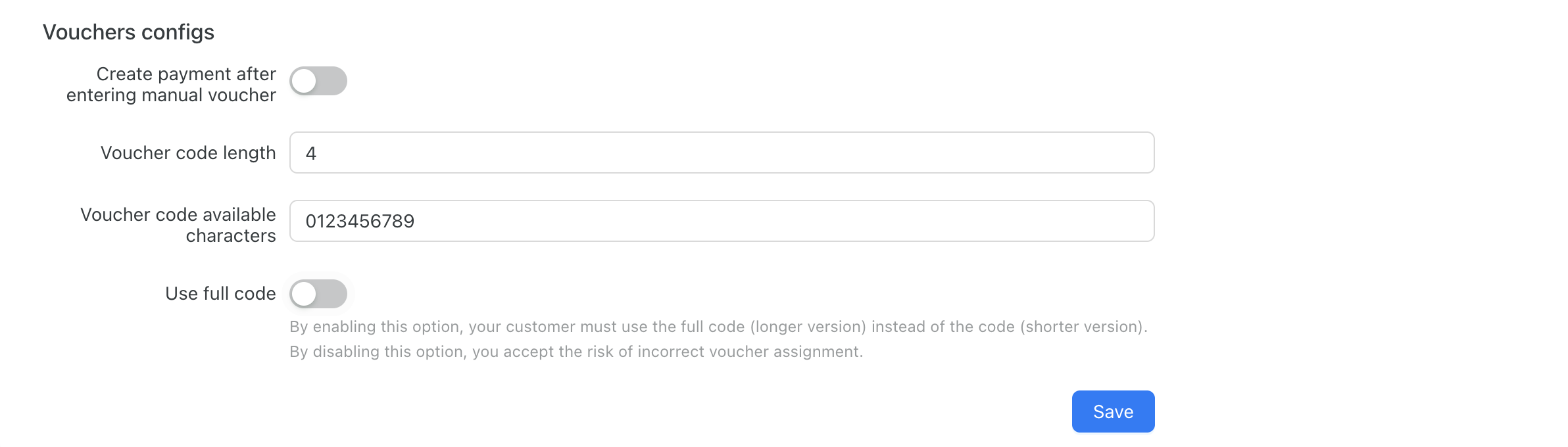
Sometimes, our clients need to provide their customers with the ability to log in using a short voucher code instead of the full one.
For example, if a printed voucher has the full code formatted as “202502-SUP-6937”, users would like to use just "6937" to log in quickly.
To achieve this, you need to disable this option, set the "Voucher code length" to 4 and use only digits in the "Voucher code available characters" field:
Vouchers export
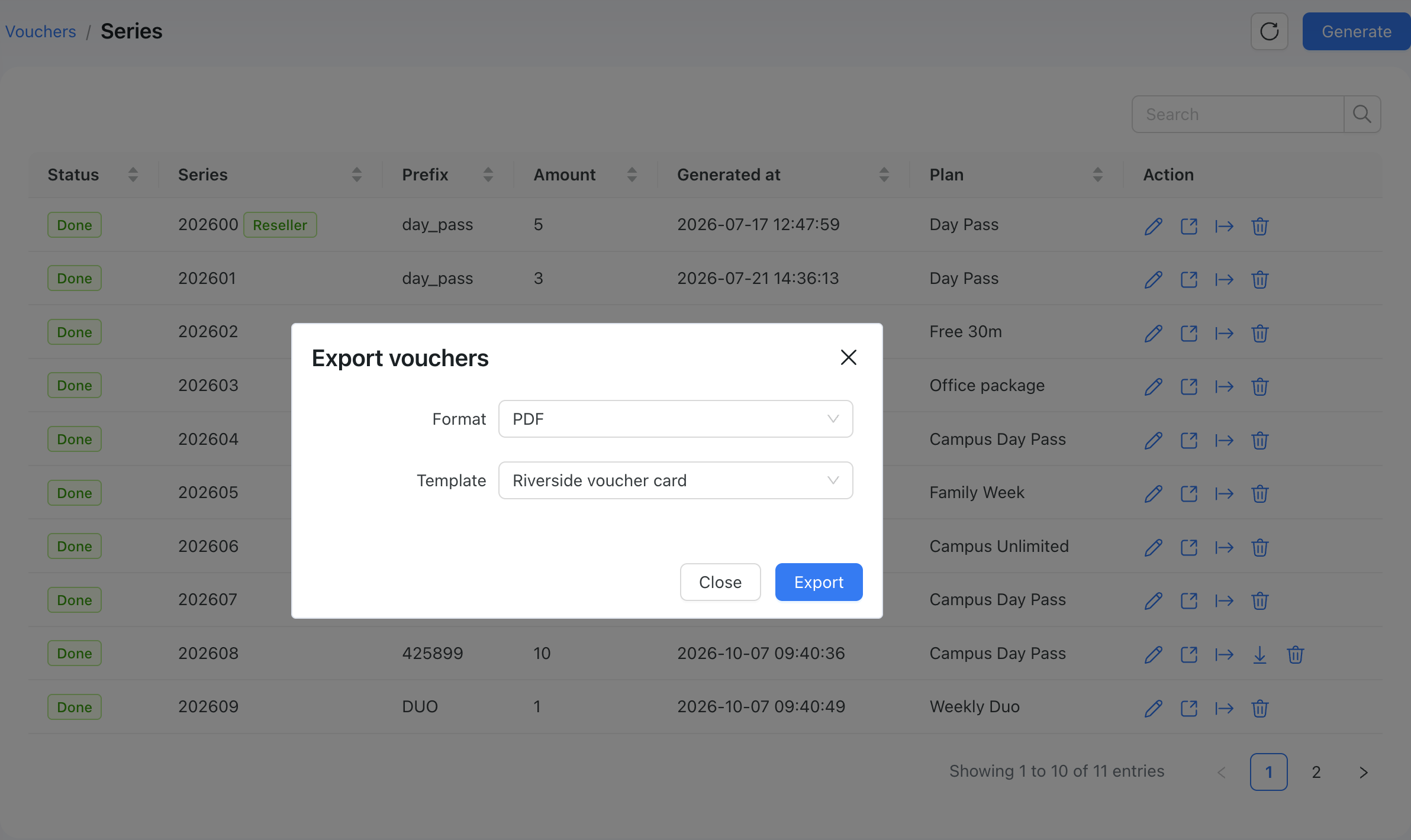
In Powerlynx, you can generate a series, export it, and then print. To do this, go to Vouchers/Series, generate a series, and click on the "Export" button under the desired series:
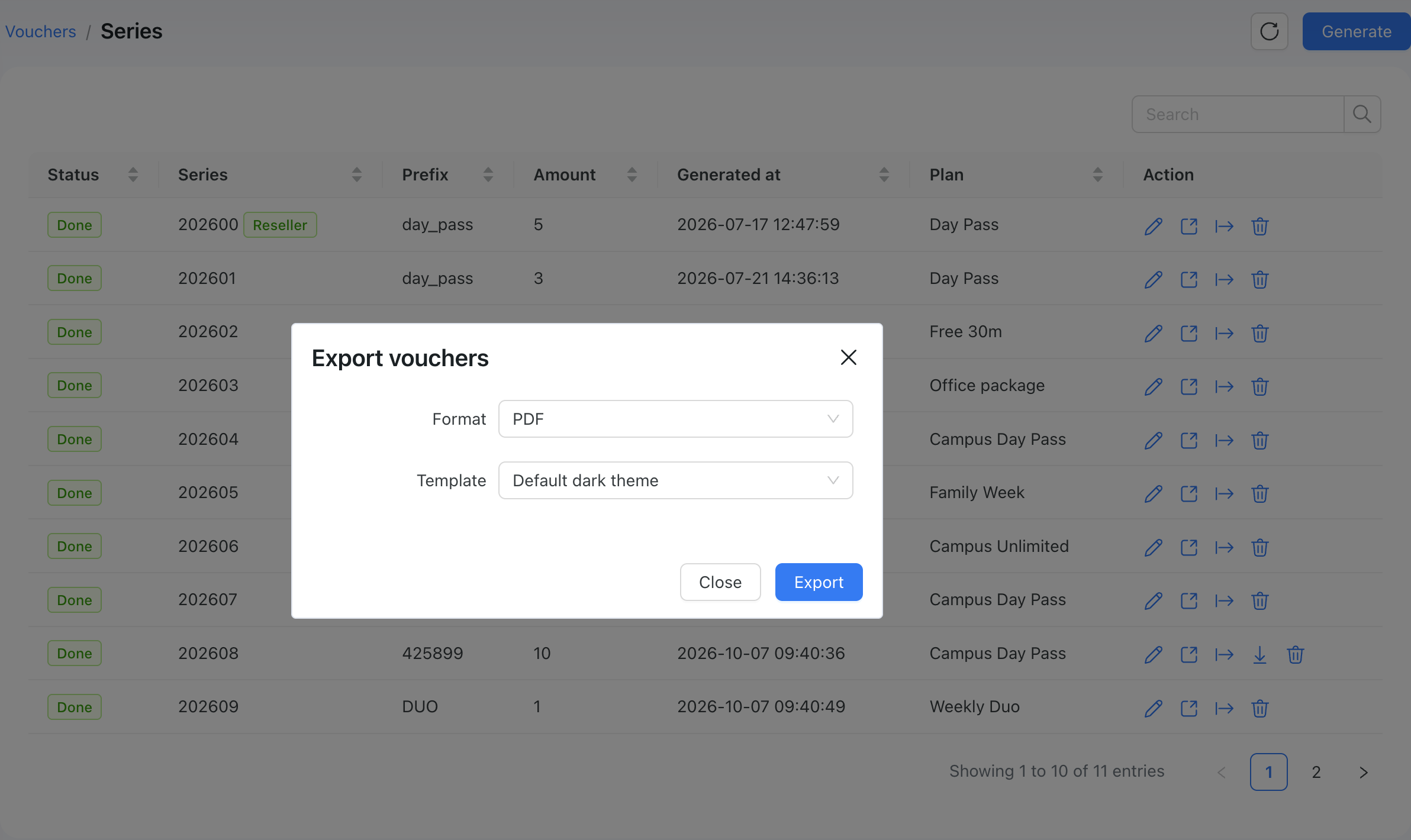
Here, you can select the format (PDF, CSV) and choose the template for the PDF format. After that, click on the "Export" button. This action will initiate a process to create a file. Once the file is ready, you will see a new button appear under the series.
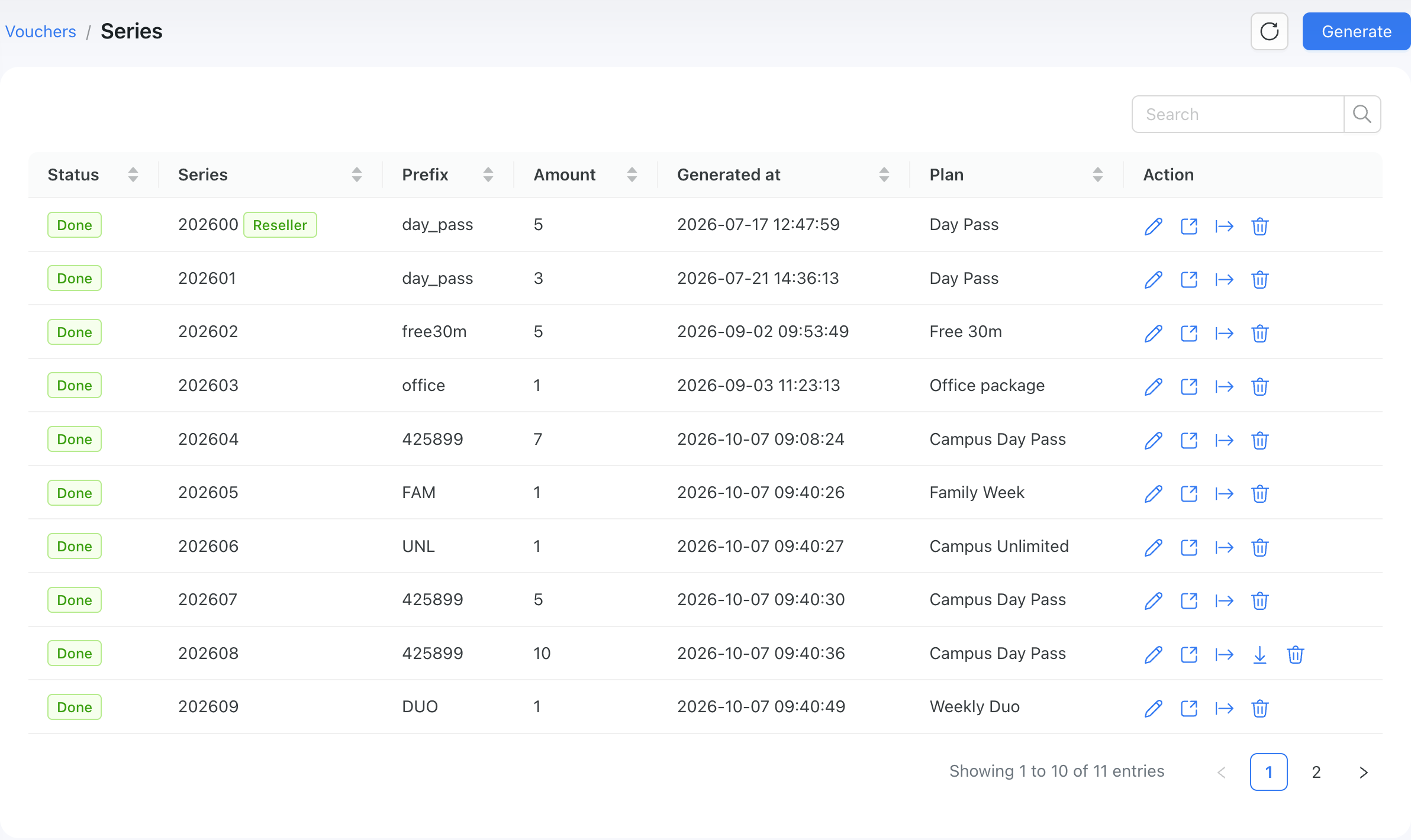
To download a file, please click on the button provided.
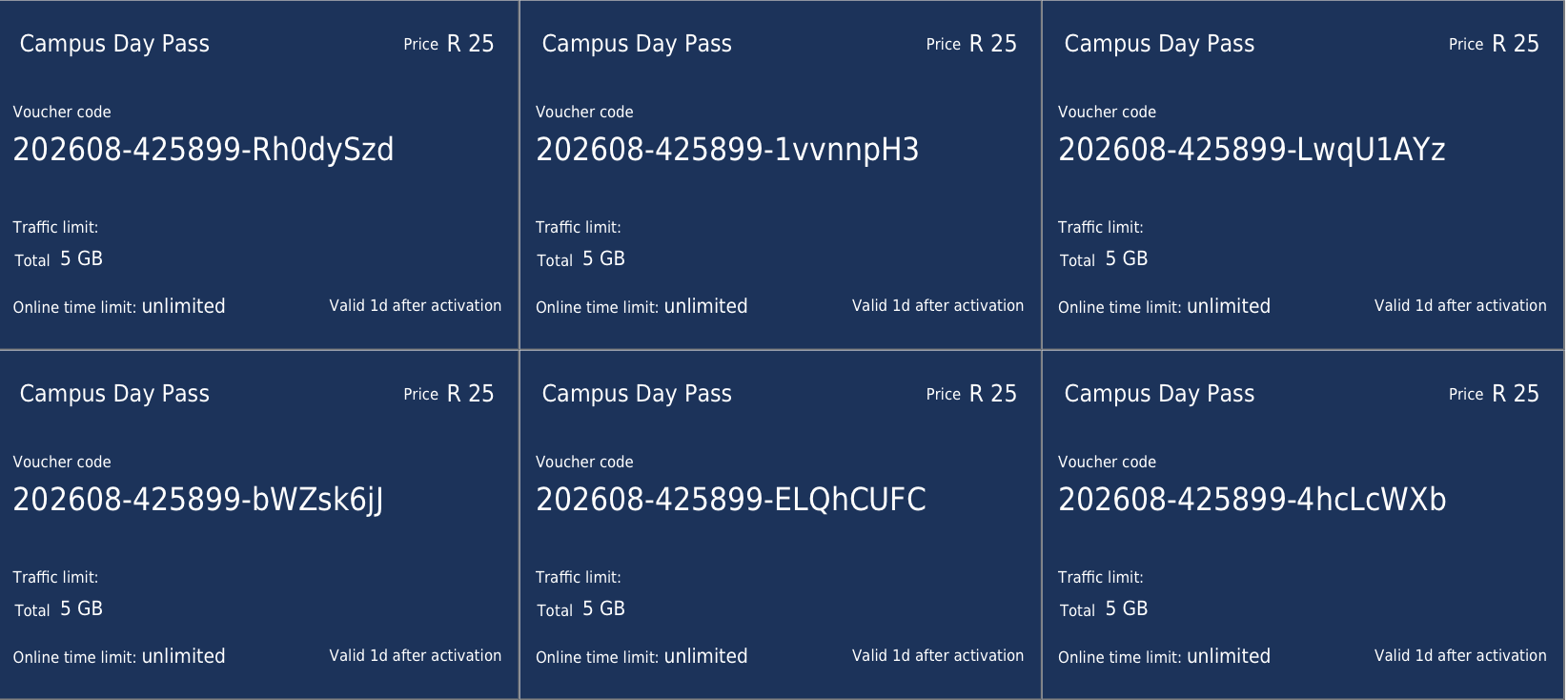
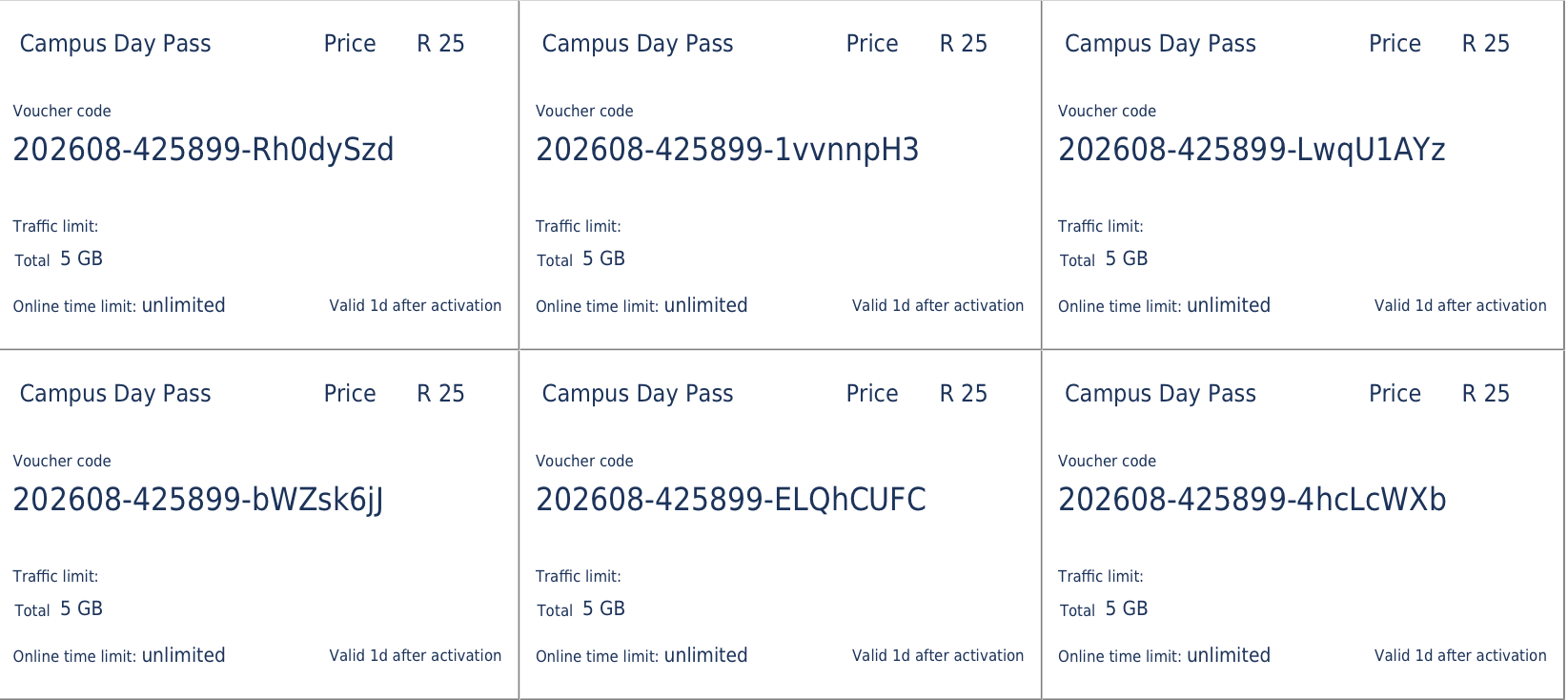
There are two themes that you can choose from when saving a file in PDF format.
Dark theme
Light theme
Vouchers PDF customization
By default, we provide two PDF voucher templates — one with a dark theme and one with a light theme. However, you can also create your own custom design for exported PDF vouchers.
To do this, go to Config → Templates → Voucher PDF:
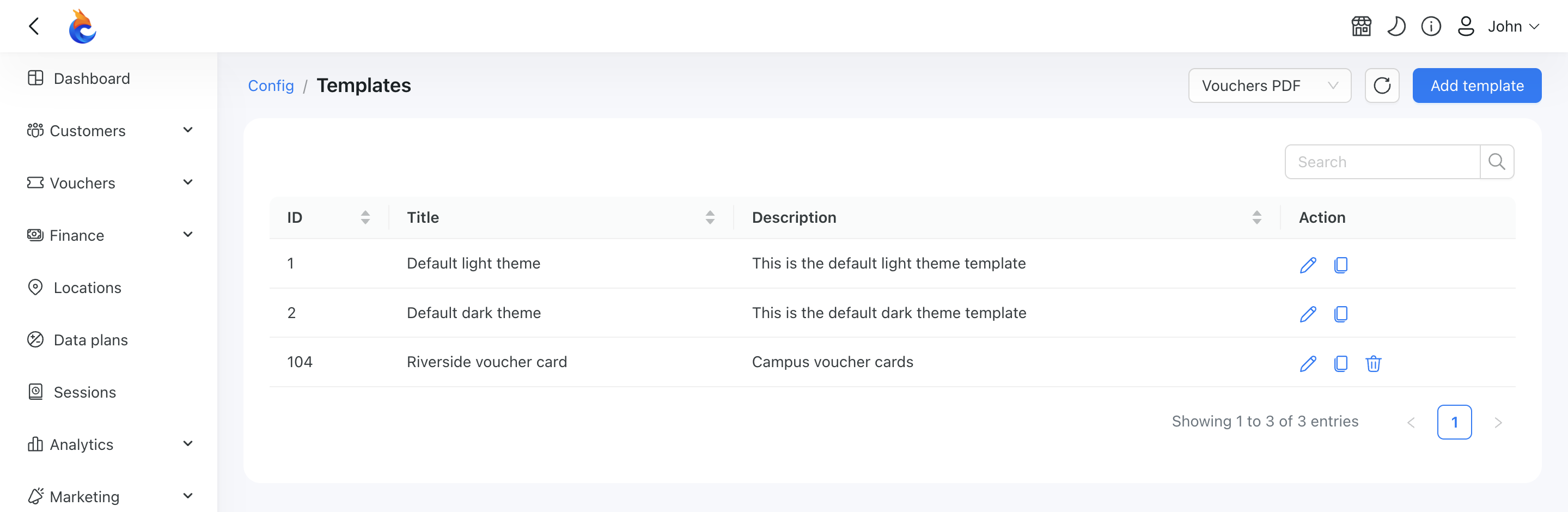
Default templates cannot be removed, only edited. To create your own template without changing a default one, use the Duplicate action on a default template — Powerlynx creates a copy named "Copy of …" that you can rename and edit:
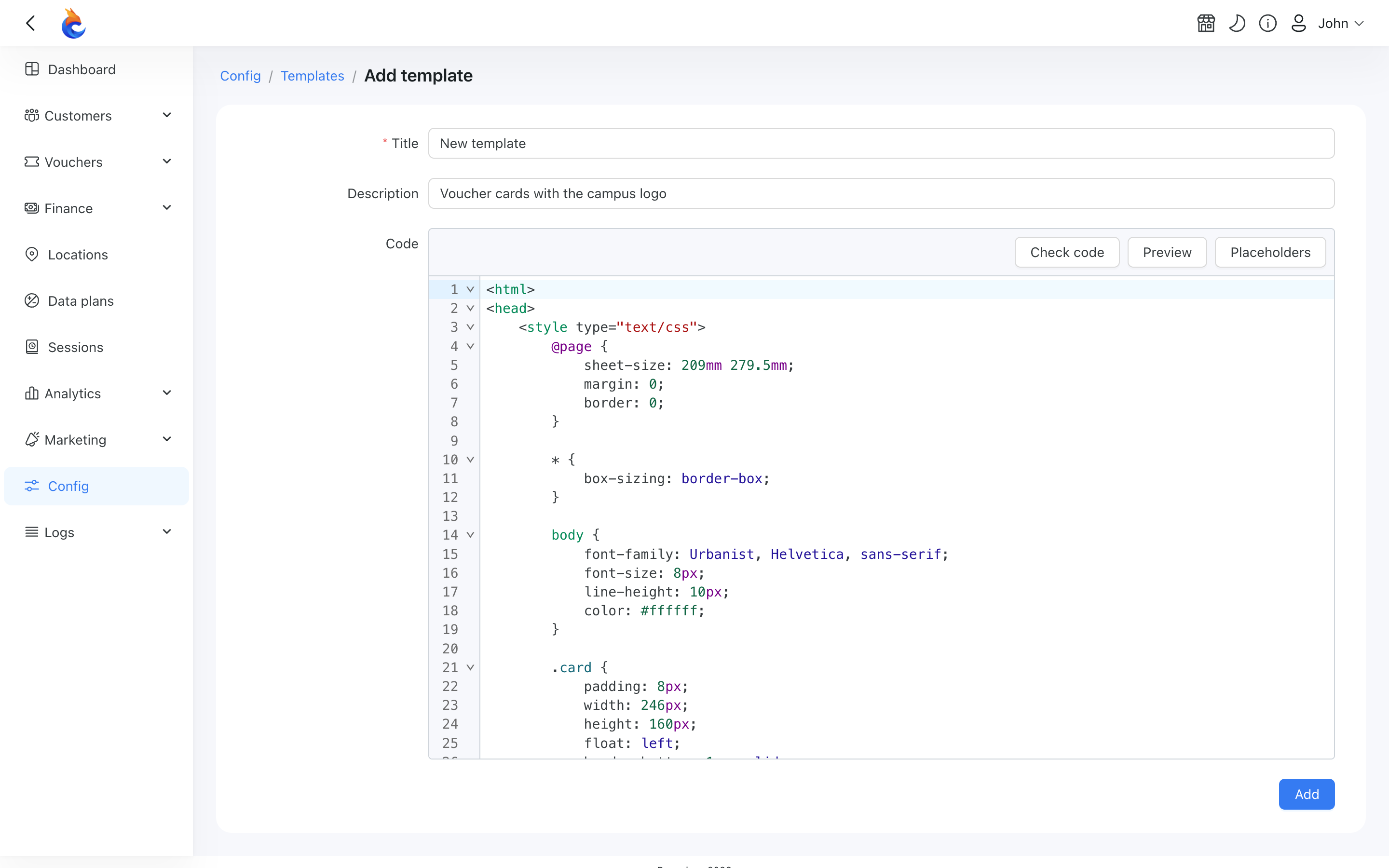
Editing a template's code requires development skills in HTML and CSS, but you can also use AI tools to assist with the process. The Check Code button validates your syntax and highlights any errors. The Preview button generates a PDF preview, allowing you to see the final result.
Placeholders let you insert variables to display specific voucher details such as price, speed, and more.
Once a new template is created, you can use it to export a voucher series:
Manually add related MAC addresses to vouchers
Some devices, such as Smart TVs or IP cameras, cannot open a captive portal page because they simply don’t support it — but they still need internet access. To handle this, we’ve introduced a feature that allows your clients to add the MAC addresses of such devices during the sign-up process. Additionally, administrators can manually add a MAC address to the corresponding voucher.
On the captive portal. To let customers add devices themselves, enable Prompt additional devices input in the data plan settings. This is a per-plan option, so enable it only for the plans where it's needed:

In the admin panel. On any voucher's page you can add a device's MAC address with the Add button in the Associated devices block — this doesn't depend on the plan option. The button is shown while the voucher has a free device slot:
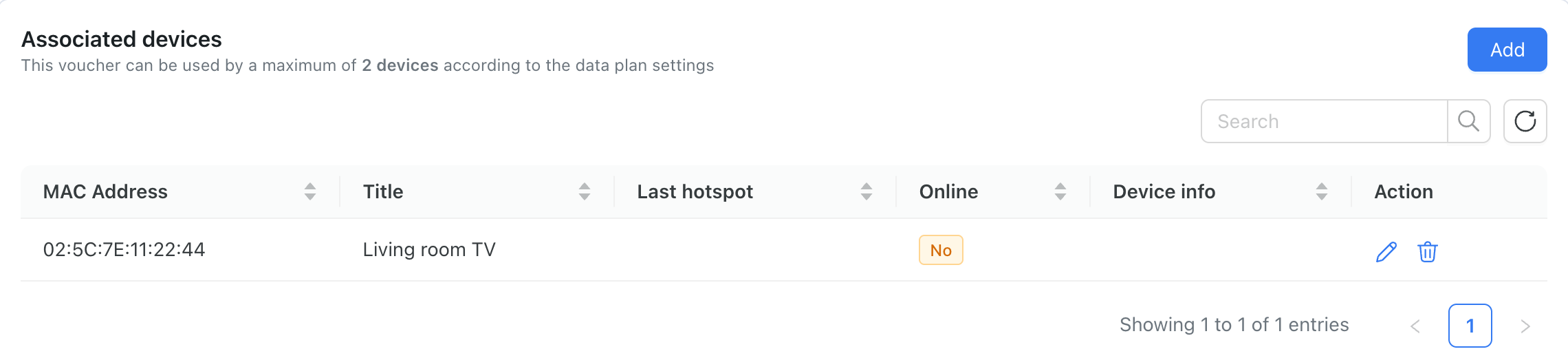
For the voucher shown in the screenshot, you can add up to 2 MAC addresses (as defined in the data plan settings). Simply click the "Add" button to manually add a new one.
Adding devices on the captive portal
On the captive portal, customers can do this themselves. After the payment or ad step, a customer whose plan allows more than one device is shown the Add a device step. It is a single screen, and from top to bottom it holds three things:
A heading with a counter, such as 2 of 3 used. The phone the customer is browsing on always occupies one slot, so a plan allowing three devices leaves two to fill. On a plan with no device limit the counter only shows how many are in use and nothing is capped.
The devices the account already knows. Nobody remembers their Smart TV's MAC address, and typing one on a phone is worse — so instead of an empty field, the customer gets a list of every device they have connected with before, including the ones they used at your other locations. Each row carries a Link button that attaches that device to the voucher they just bought; pressing it again turns it into Unlink.
A manual form, below an or divider, for a device neither the customer nor the location has seen before. Add appends a MAC address field, as many as the plan still allows.
A Continue button at the end saves everything and returns the customer to the flow. A customer who doesn't want to add anything just presses it and moves on.
What the rows in that list look like:
- Each device is titled by whatever identifies it best: the model and system Powerlynx recognised, otherwise the name the customer or your operator gave it, otherwise its MAC address.
- The device the customer is browsing from is marked This device and has no button — it is already on the voucher.
- Once the slots are full, the Link buttons of the remaining devices are greyed out.
- A device that is still working on another of the customer's plans says so underneath its MAC address. Linking it here moves it to this voucher, which takes it off the other plan and drops that connection.
Nothing is saved while the customer taps through the list. The whole selection — linked devices plus any MAC addresses typed by hand — is stored only when they press Continue.
Once added, the device will be able to connect to the same WiFi network and will be authorized instantly.
TIP
The selection isn't one-way. A customer can come back to the step and change it: unlink a device they no longer carry, link another in its place. Submitting the page again simply replaces the previous selection.
WARNING
Unlinking a device that is currently online disconnects it immediately, and the same happens to a device moved here from one of the customer's other plans. This is deliberate — the freed slot becomes available at once, so without the disconnect a customer could keep more devices online than the plan allows.
A device that gets unlinked is only released from the voucher, never deleted: it stays on the customer's account with its name and history, ready to be linked again.
If a customer types a MAC address that is already registered to a different customer at that location, the page refuses it with an alert and saves nothing — someone else's device is never taken over, and the customer is not told whose it is. Your operators can still make that move from the admin voucher page, where they are shown who owns the device and can confirm it.
Logging out on the captive portal
A customer whose device is recognised sees Logged in as … with a Log out button above the plans on the splash page. After confirming, the device is unlinked from their account, its connection is closed, and they are taken back to the login page — for example, to sign in with a different phone number. The next time the device connects, it has to sign in again.
If you have blocked the customer under Access control, logging out does not release the device.